"Centrally located."
It’s the most common phrase in hospitality marketing—and in 2026, it’s also the most useless.
Central to what? The airport? The convention center? The Taylor Swift concert? The quiet park perfect for a morning run?
For decades, hotels have treated location as a static feature—a pin on a map. But for your guests, location is dynamic. It changes based on why they are traveling. A location that is "perfect" for a business traveler attending a conference might be "terrible" for a family seeking a quiet retreat.
We call this disconnect the Context Gap. It’s the void between your hotel’s physical coordinates and your guest’s specific intent. And it is where booking conversions go to die.
The High Cost of "Location Anxiety"
Research shows that travel planning is stressful. Expedia found that 75% of travelers find booking accommodations "emotionally draining," often due to decision fatigue. A massive contributor to this fatigue is Location Anxiety: the fear of the unknown.
- "Is it safe to walk from the hotel to the venue at night?"
- "Will I be stuck in traffic if I stay here?"
- "Is 'near the beach' actually a 20-minute hike?"
When a guest reads "conveniently located" on your website but can’t find specific answers to these questions, they don't just guess—they leave. They bounce to Google Maps, or worse, to an OTA or a competitor who does explain the context.
Static Pins vs. Dynamic Intent
The problem isn't your location; it's how you describe it.
Most hotel websites rely on a static "Nearby Attractions" list: a bulleted graveyard of landmarks that hasn't been updated since the site launched.
- Eiffel Tower (2 km)
- Louvre Museum (3 km)
- Charles de Gaulle Airport (25 km)
This data is accurate, but it’s context-free. It fails to address the dynamic intent of the traveler.
Consider two guests looking at the same London hotel:
- The Swiftie: Traveling for the Eras Tour at Wembley.
- The Founder: Pitching investors in Shoreditch.
To the Swiftie, your "Central London" location is irrelevant if you don't explain the transport link to Wembley. To the Founder, proximity to tourist traps is a bug, not a feature—they want to know about the co-working space next door.
The "Right Location" is a narrative, not a coordinate. It’s the ability to say: "For seeing Taylor Swift, we are 15 minutes by direct tube—no transfers, safe walk to the station."
The Event-Driven Demand Surge
In 2025 and 2026, we’ve seen the rise of "Event-First Travel." Guests are increasingly booking trips around specific moments—concerts, sports finals, festivals—rather than destinations.
Data from booking platforms confirms that proximity to events often overrides price and brand loyalty. Guests will pay a premium for the certainty of a smooth logistics experience.
If your content doesn't explicitly link your property to these events, you are invisible to this high-intent traffic. You might be the closest hotel to the stadium, but if your website doesn't say it, the guest (and the search engine) won't know.
The Dual Audience: Humans and Agents
Here is where it gets trickier. In 2026, you aren't just writing for humans; you're writing for AI agents.
- The Human Guest needs the "vibe" and safety assurance. They need to feel good about the walk.
- The AI Agent (like Perplexity or a booking bot) needs structured data. It needs to know
distance: 1.2km,transit_time: 12 min,transport_mode: walking.
If you only have the "vibe" copy ("Just a stone's throw away!"), the AI can't compute the logistics and won't recommend you. If you only have the data ("1.2km"), the human feels no emotional reassurance.
You need both. You need Dual-Layer Content: rich narratives for the user interface, and structured schema markup for the bots.
Closing the Gap with Evenue
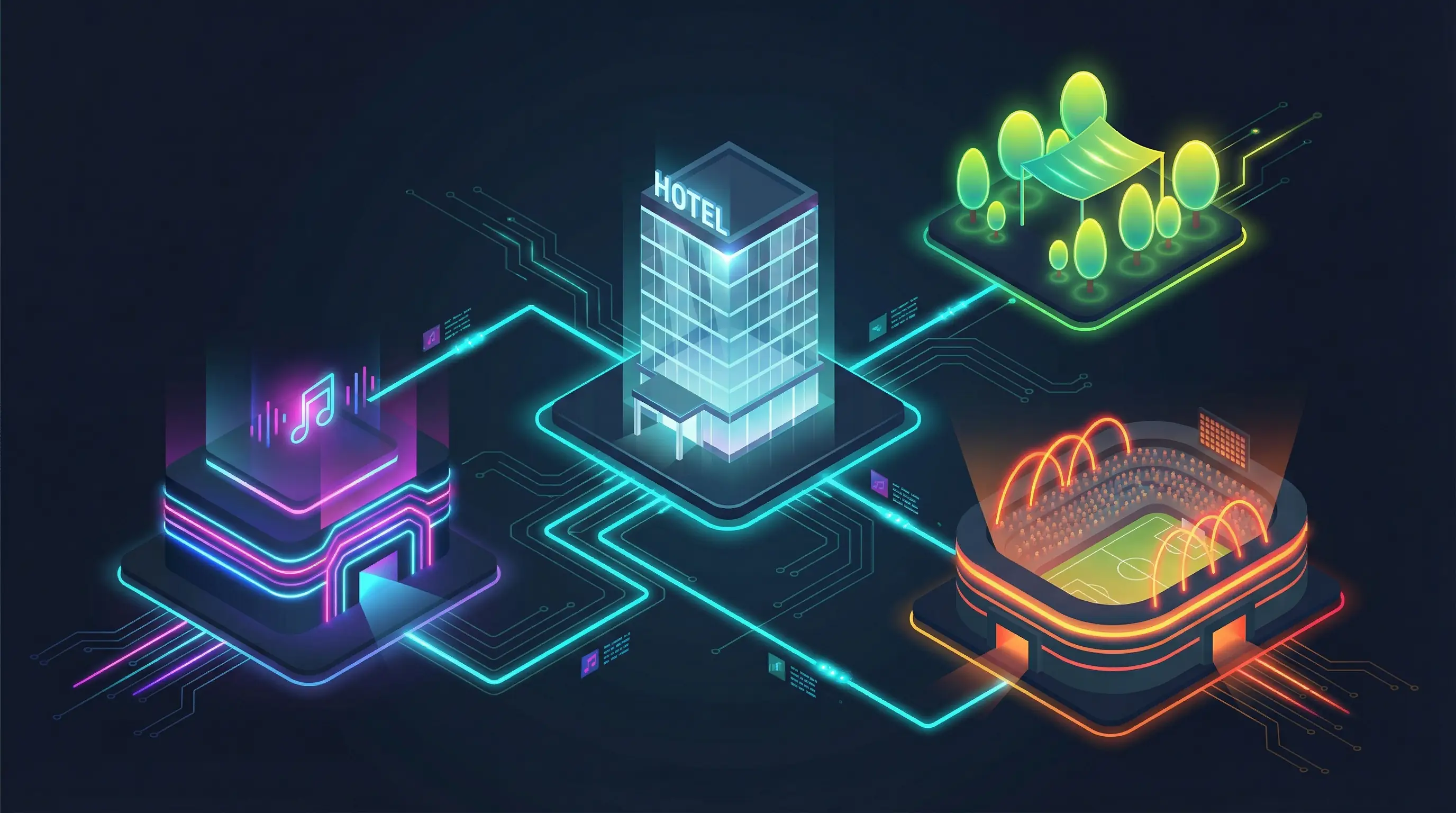
This is why we built Evenue. We realized that no human marketing team can manually write thousands of personalized location stories for every concert, conference, and guest profile.
Our platform automates Context Engineering:
- Identifies the events and venues driving demand for your dates.
- Profiles the guests likely to attend (e.g., Families vs. Couples).
- Generates rich, specific content that connects your hotel to their intent.
- Structures that data for AI agents, ensuring you are visible to the new wave of search.
Stop selling a "good location." Start selling the right location for your guest's specific mission. When you close the Context Gap, you don't just get a booking—you get a relieved, confident guest who feels like they’ve found exactly what they were looking for.